ade-catalog · understand
Discover, organize, and put your data assets to work.
ade-catalog finds the data assets scattered across your analytics platforms and turns them into one navigable catalog: what exists, how it is connected, and what it means. Browse it in the app, ask it questions in plain language, or plug it into the LLMs and tools your teams already use. It supports data discovery, assessment, and ongoing monitoring, for analysts, architects, and anyone joining a project who needs the map before the work.
live Live web app; open-source core on GitHub.
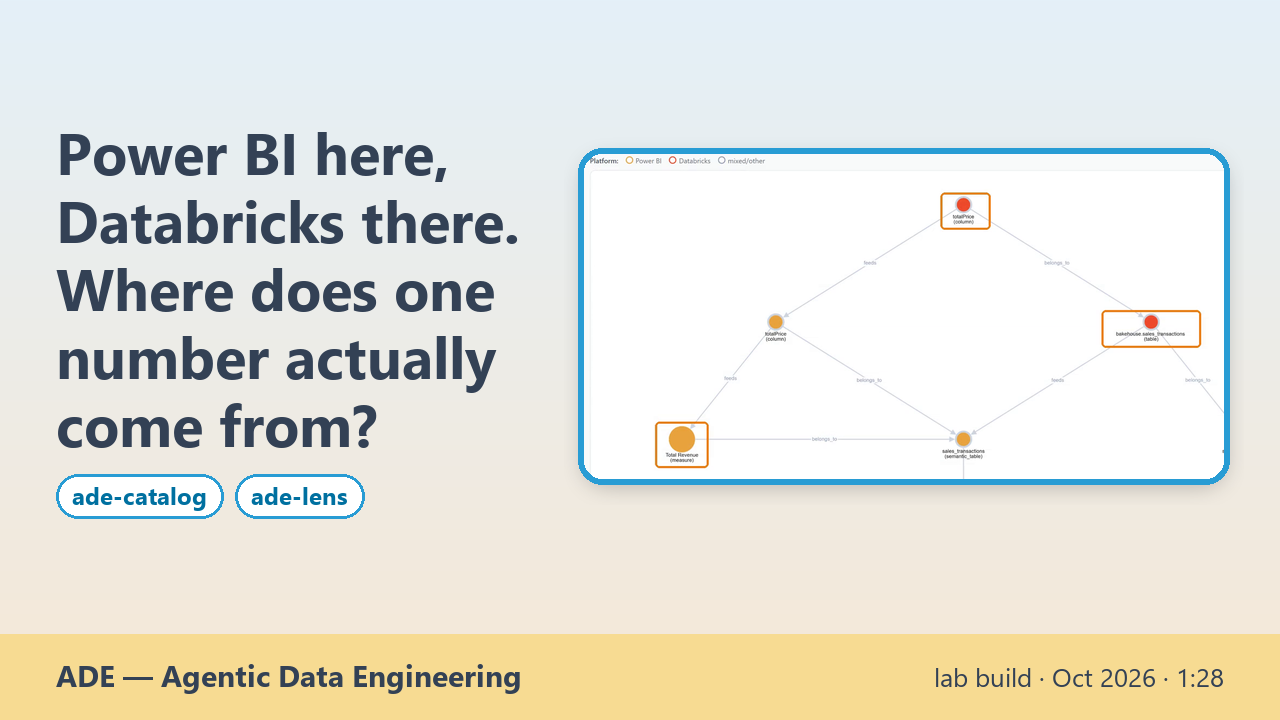
Power BI here, Databricks there. Where does one number actually come from?
A data estate is rarely one platform: here the reports are in Power BI and the data in Databricks.
What you get
Cross-platform lineage
Trace where data comes from and where it is used, end to end, across tool boundaries: from the tables and notebooks to the reports people read.
AI-assisted, human-reviewed
Generated descriptions you review and edit. Human edits are protected and never silently overwritten when the catalog is scanned again.
A catalog assistant
Ask in plain language and get answers grounded in your own metadata, with links straight to the objects.
Open integrations
An open MCP interface plugs the catalog into the agents and tools your teams already work with.
How to start
Open the app to see a catalog built on synthetic demo data. To map your own estate, run ade-catalog locally from the open-source repository: scan the platforms your organization uses, browse the results on your own machine, then publish them when you want to share the catalog with your team.
What it does not do
- It catalogs metadata: objects, definitions and the links between them. It is not where your data lives, and it does not move or copy it.
- Generated descriptions are drafts for a person to review, not facts to publish unread.
- The hosted app needs a sign-in. The open-source core on GitHub trails it: not every connector in the app is in the public repository yet.
- Lineage reaches as far as the scanners can read. A hop that no scanner parses is a gap in the graph, not a guess.
See it working
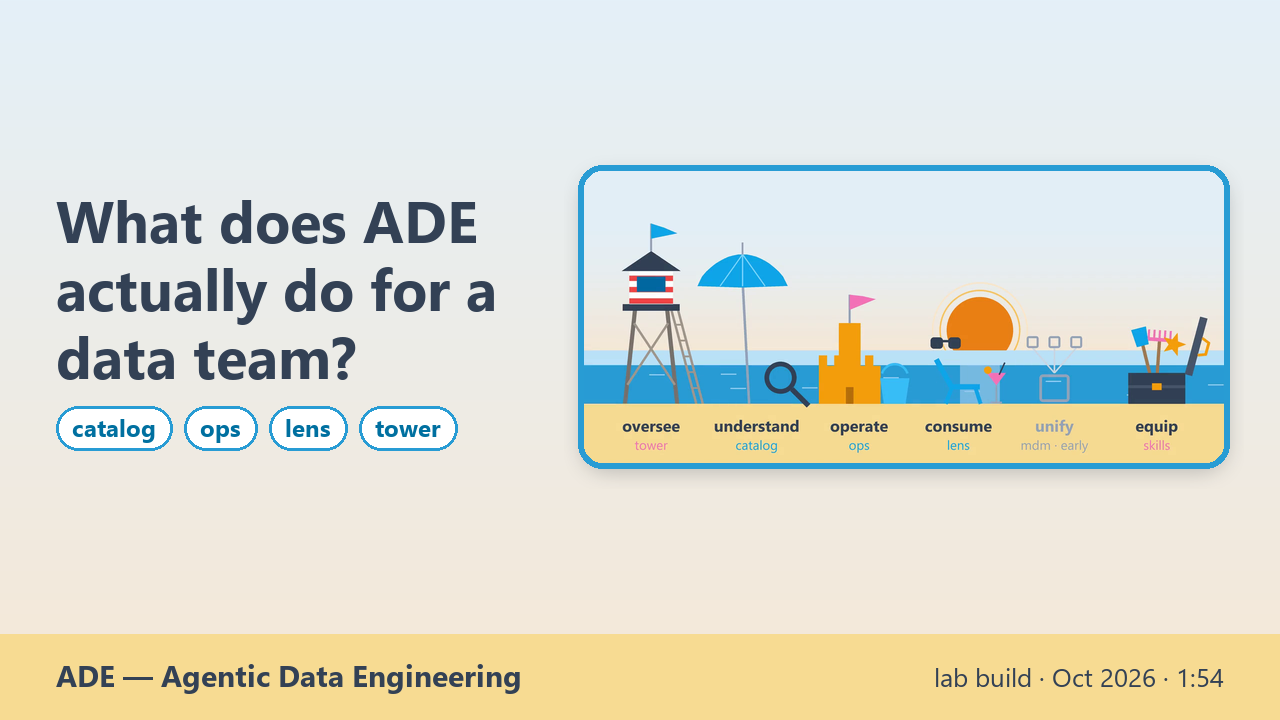 ▶ 1:54What does ADE actually do for a data team?lab build · Oct 2026 ade-catalog · ade-ops · ade-lens · ade-tower
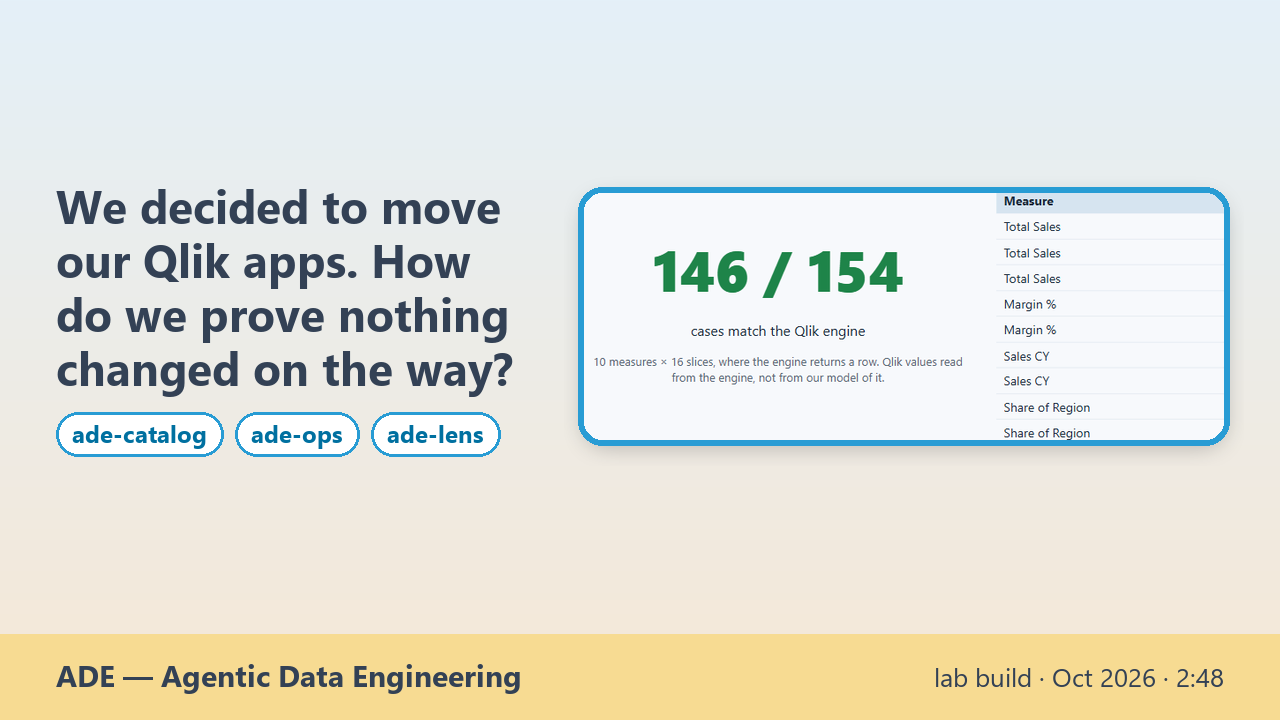 ▶ 2:48We decided to move our Qlik apps. How do we prove nothing changed on the way?lab build · Oct 2026 ade-catalog · ade-ops · ade-lens
From the agent diary
What the family's agents learn while they work →
Part of the ADE family
ADE — Agentic Data Engineering — is a family of independent, composable open-source tools for the data estate: understand what exists, operate it in plain language, and consume the certified answers people need, with people and AI agents working under rules you set and track. Use each one on its own or together.